
01
Size the source to your everyday thickness
Not the thickest sheet the machine can manage on a datasheet — the thickest one that goes through the shop every week. Sizing for the rare heavy job means paying for power you idle most days.
Machine category 02
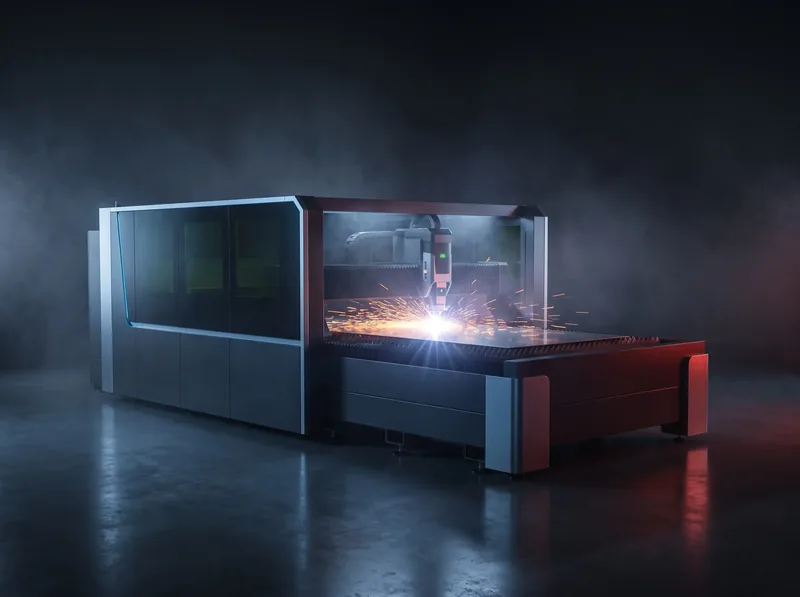
Open-table and enclosed cutters, plus laser welding — the fastest route from a sheet to a finished edge.
Fiber laser changed the economics of sheet work: an edge clean enough to weld or paint without a second operation, and a nest that changes as fast as you can redraw it. For most Egyptian workshops it replaces a plasma table, a shear and a lot of grinding.
The decision is rarely about the laser itself. It is about the source power against the thickness you actually cut every week, and about assist gas, which is the running cost nobody puts in the quotation.
01
Not the thickest sheet the machine can manage on a datasheet — the thickest one that goes through the shop every week. Sizing for the rare heavy job means paying for power you idle most days.
02
Nitrogen gives a clean, weldable, paintable edge on stainless and aluminium and costs considerably more per hour than the electricity. Oxygen is cheaper on mild steel but leaves an oxide the next process has to deal with. Decide this before you decide the machine.
03
An enclosure is about safety, fume extraction and consistency, and it is what most factory inspections expect to see. An open table loads faster and suits a shop where sheets arrive by crane.
04
The cooling and fume extraction are part of the machine, not options. We size them with the machine and check your incoming supply before quoting.
Plasma still wins on thick plate and on price. Fiber wins on edge quality, on thin and medium sheet, on accuracy, and on anything that goes straight to welding or paint without dressing.
Yes, with the right assist gas and settings. Reflective materials such as aluminium and brass need the machine specified for them from the start, so tell us your material mix before we quote.
Site preparation is the variable, not the machine. Once power, air and extraction are ready, commissioning and operator training are a short, scheduled job — we survey first so the dates hold.
An engineer reads every request. Usually the same working day.